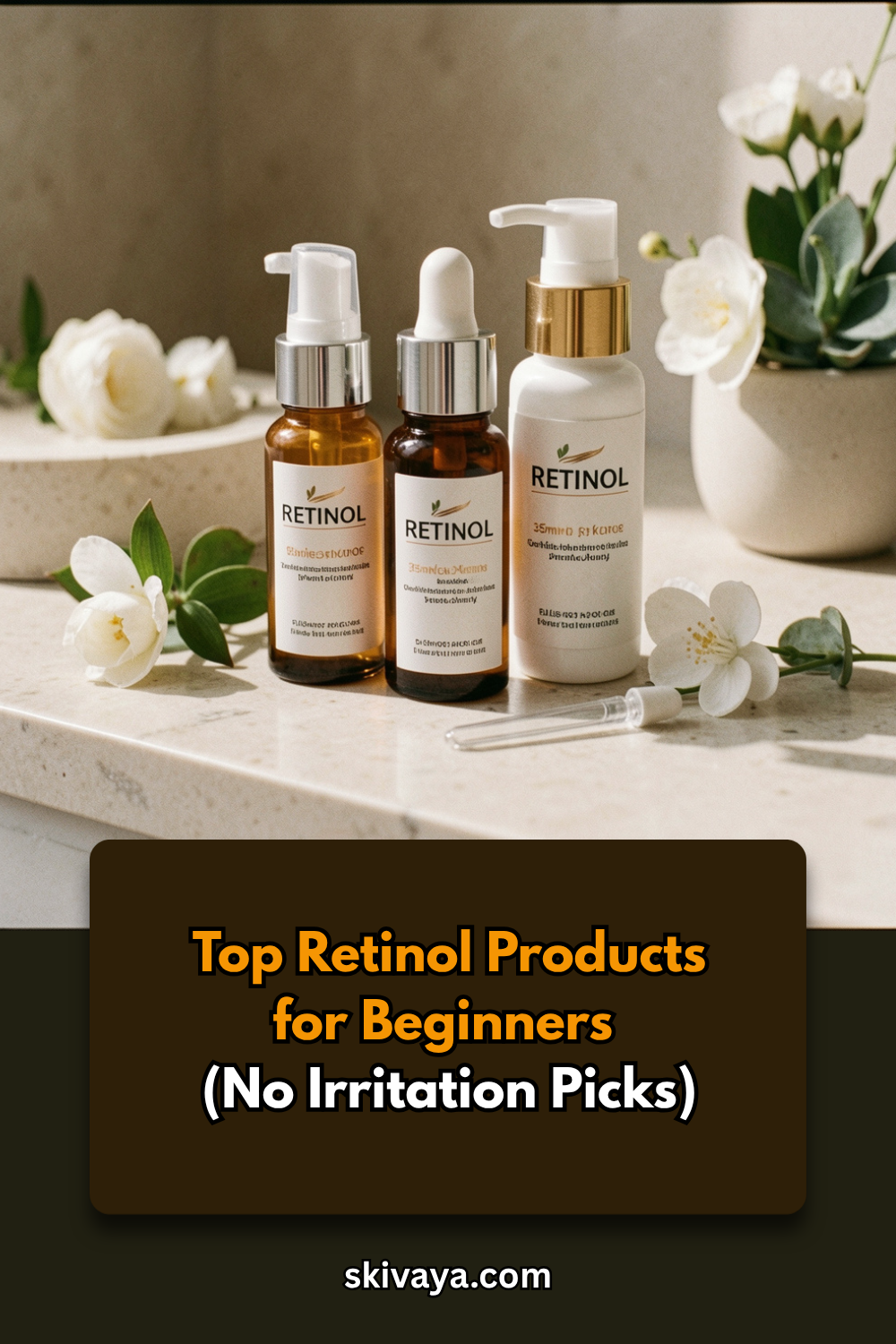
You’ve heard it a thousand times: retinol is the gold standard in anti-aging. And it’s true. No other over-the-counter ingredient comes close to retinol’s ability to boost collagen, accelerate cell turnover, fade dark spots, and smooth out fine lines. But here’s the catch nobody talks about upfront — the way you start with retinol determines whether your skin glows or goes haywire.
I’ve seen patients come in red, flaky, and frustrated because they jumped straight into a 1% formula five nights a week. That’s not a retinol problem. That’s a product selection problem. The right beginner retinol should do the hard work quietly, without your skin ever staging a protest.
Here are the picks I actually recommend — and why each one earns its spot.
Disclaimer
“This Blog is completely reader-supported, for any purchase you make from affiliate links on this blog we earn a small commission with no extra cost to you, This content is for informational purposes and not medical advice.”
Why retinol actually works
Retinol is a vitamin A derivative. Once applied, your skin converts it into retinoic acid — the active form that signals your cells to turn over faster, produce more collagen, and stop excess melanin from clustering into dark spots. Think of it as a reset button for tired, sun-damaged, or aging skin.
The reason beginners run into trouble isn’t the ingredient itself — it’s the concentration and delivery system. Starting too strong or using it too often overwhelms the skin barrier before it has a chance to adapt. That’s exactly why the products below are formulated the way they are.
Dermatologist note: Start with a concentration between 0.1%–0.3% if you’ve never used retinol before. Anything above 0.5% without a tolerance build-up is asking for irritation, dryness, and that dreaded “purge state.”
The 6 best beginner retinol products
1. CeraVe Resurfacing Retinol Serum

Encapsulated retinol · Fragrance-free · Drugstore accessible
This is the first retinol I point my patients toward. It uses encapsulated retinol, which slowly releases the active ingredient over hours rather than all at once — meaning far less redness and peeling. The ceramides and niacinamide in the formula actively work to soothe and reinforce your skin barrier while the retinol does its job. It’s non-comedogenic, dermatologist-tested, and won’t drain your wallet. An almost unfair value for what it delivers.
2. The Ordinary Retinol 0.2% in Squalane

0.2% retinol · Oil-based · Budget-friendly
My personal favorite, nothing works better than this at this price point, if you are a beginner just close your eyes and try this. For the person who wants to spend as little as possible while still getting legitimate results — this is it. The 0.2% concentration is beginner-ideal, and squalane (a skin-identical emollient) buffers the retinol so it doesn’t strip your moisture barrier. The oil format also makes it easier to blend into your nighttime routine without that tight, dry feeling. Just don’t stack it with acids or vitamin C on the same night.
3. La Roche-Posay Retinol B3 Serum

Pure retinol + Vitamin B3 · Sensitive skin focused · Dermatologist brand
La Roche-Posay built their reputation on sensitive skin. This serum pairs retinol with vitamin B3 (niacinamide) specifically to blunt the irritation response. If you’ve tried retinol before and it didn’t go well, this is your second chance. It works gradually, consistently, without the tightness or redness that makes people give up. Use it every other night at first and let your skin tell you when it’s ready for more.
4. RoC Retinol Correxion Line Smoothing Serum

Pure retinol · Hyaluronic acid · Fragrance-free
RoC has been in the retinol game longer than most brands — and it shows. This serum is formulated to stay moisturizing for up to 24 hours thanks to hyaluronic acid, which means you’re less likely to wake up with that parched, flaky feeling. It’s fragrance-free, which removes one of the most common culprits behind retinol-adjacent irritation. If you’re targeting fine lines specifically, this is an excellent, time-tested choice.
5. SkinMedica Age Defense Retinol Complex 0.25

0.25% retinol · Bakuchiol blend · Clinically backed
This one sits at the premium end of the beginner range — and for good reason. SkinMedica blends retinol with bakuchiol, a plant-derived retinol alternative that works synergistically to deliver results without doubling the irritation risk. It’s the product board-certified dermatologists reach for when they want a gentle-but-serious formula. If you’re investing in your skin and don’t want to mess around, this earns every dollar.
6. Sunday Riley A+ High-Dose Retinoid Serum

Oil-based retinol · Anti-inflammatory herbs · Luxury pick
If budget isn’t a concern and you want your retinol experience to feel luxurious, Sunday Riley delivers. The oil format keeps dryness completely at bay, and the formula includes blue-green algae and licorice root to fight inflammation alongside the retinol. One caveat: apply it to freshly cleansed skin and give it a full five minutes before layering anything else on top. It’s that potent, even at a beginner-friendly concentration.
Which one is right for your skin type?
- Dry or sensitive skin: The Ordinary in Squalane or La Roche-Posay Retinol B3. Both have hydrating buffers built in.
- Normal / combination: CeraVe Resurfacing Retinol Serum. Lightweight, barrier-friendly, and very well tolerated.
- Acne-prone: CeraVe or PCA SKIN Clarity Treatment. Non-comedogenic formulas that also tackle post-acne marks.
- Mature / fine lines focus: RoC Correxion or SkinMedica 0.25. Both are built for collagen-boosting over time.
- Budget-first: The Ordinary at ~$10 is genuinely hard to beat for what it delivers at that price.
- Willing to splurge: Sunday Riley for the full luxury experience. SkinMedica if you want clinical credibility.
How to introduce retinol without freaking out your skin
The single most common reason people abandon retinol? They started too fast. Here’s the exact protocol I walk my patients through:
- Start with twice a week: Monday and Thursday nights only. Let your skin recover in between. Do this for the first 2–3 weeks.
- Apply the “moisturizer sandwich” method: Apply a light moisturizer first, then retinol on top, then seal with another layer of moisturizer. This buffers the active and dramatically cuts irritation.
- Use a pea-sized amount. That’s it: More product does not mean faster results. A pea-sized amount covers the entire face. Going heavier only increases irritation risk.
- SPF every single morning: Retinol accelerates cell turnover, which makes your fresh new skin cells more vulnerable to UV damage. Skipping SPF while using retinol actively works against you.
- After 4 weeks with no issues: increase to every other night: From there, build toward nightly use over the following month. Let your skin set the pace — not the packaging.
Mistakes that cause irritation (and how to avoid them)
- Using retinol with acids on the same night. Layering retinol with glycolic acid, salicylic acid, or vitamin C at once overwhelms the barrier. Alternate nights instead.
- Applying on damp skin. Wet skin absorbs retinol faster and deeper — which sounds good but increases irritation significantly. Always apply to fully dry skin.
- Quitting after two weeks because “nothing is happening.” Retinol results are measured in months, not weeks. Collagen remodeling takes time. Consistency beats intensity every time.
- Skipping moisturizer after. Retinol without a follow-up moisturizer is one of the top causes of that dreaded peeling and tightness. Seal it in every single time.
- Using retinol around your eyes without an eye-specific formula. The skin around your eyes is thinner and far more sensitive. Use a retinol eye cream (like Kate Somerville’s or The INKEY List’s Retinol Eye Cream) for that zone separately.
Recommended
My Client Had Persistent Acne — This Routine Changed Everything
The Dermatologist-Approved Acne Routine That Cleared My Client’s Skin in 30 Days